Suprematism      Monochromes       Nothing       Radical Art [Home Page]    


From Suprematism to the Monochrome


Kazimir Malevich: Suprematism (1915-1920)


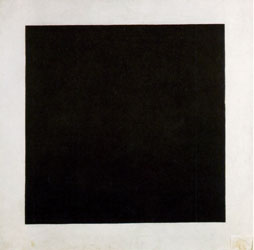
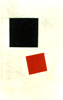
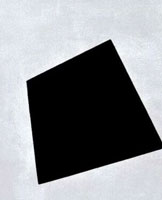
Black Square, 1915

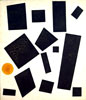
The suprematist paintings by Kazimir Malevich and his disciples depict constellations of shapes in a white space. The shapes and their constellations are defined by an algebra with only one elementary term: the black square. The black square is the icon of Suprematism. It is the initial symbol of a generative system which generates all suprematist shapes and constellations by means of a repertoire of distortions, displacements, multiplications, alignments and superpositions. Malevich never articulated this combinatoric system explicitly; but it is suggested unmistakeably by the didactic arrangement of his booklet "Suprematism: 34 Drawings" (1920). The role of the black square in Suprematism is thus analogous to the role of the number zero in Peano arithmetic, or the role of the empty set in the set-theoretical reconstruction of mathematics.

The various Malevich paintings which display the black square should thus not be viewed as monochromes. They depict a very definite thing (the black square), which denotes not the passive openness of an empty space but the infinite generative power of the suprematist algebra. It is false and misleading to hang the Black Square next to a monochrome by Rodchenko, Klein or Rauschenberg. It is true and enlightening to hang it next to a slashed canvas by Fontana (to point to its violently anti-representational nature, and its ambition to open up 3D and higher-dimensional space), or next to the capital S of Chomskyan grammar (to emphasize the algebraic combinatorics of suprematism). This small group show might also include a Byzantine icon depicting Jesus Christ (to highlight the Russian context of this work, and its mystical connotations).


"Our number system (called the 'position system') has used the zero for a long time, but only in the 16th century (Cardano, Tartaglia) is the zero for the first time not considered as nothing, but as a number, as numerical reality. And only now in the 20th century, the Square is recognized as a plastic value, as the zero in the complex body of art. This fullcolored Square, stamped out completely continuously with color in a white plane, has now started to build a new space."

El Lissitzky: "Kunst und Pangeometrie." In: C. Einstein & P. Westheim (eds.): Europa Almanach. Potsdam: Gustav Kiepenheuer, 1925.


       More about the suprematist algebra

       External link: The history of the black square. (Leningrad Hermitage)


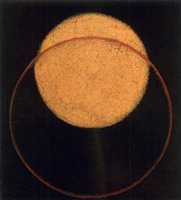
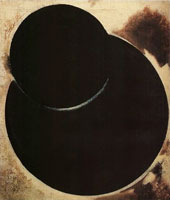
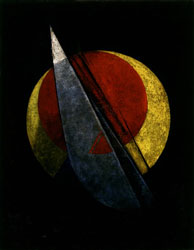
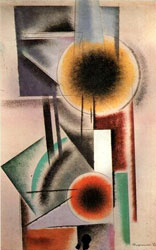
Ivan Kljun: Monochrome Shapes (1917-1923)


Untitled, 1917


Untitled, 1917


Untitled, 1917


Spherical Composition, 1923


Untitled, 1917


Untitled, 1917


Untitled, 1917


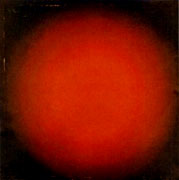
Red Light
(Spherical Composition),
1923


Kazimir Malevich: White on White (1918)


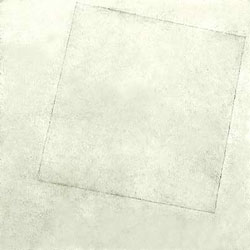
In "Suprematist Composition: White on White" (1918), Malevich displays a white square in a white space. This piece is obviously not an empty,monochrome painting – but it is difficult to resist the idea that it depicts such a monochrome. For Malevich, white was the color of space – he said this with so many words, and all suprematist paintings show it. The white square in "White on White" is thus an image of the very space it inhabits.

"White on White" is an early example of a self-referential piece – akin to Nam June Paik's "TV Buddha", various pieces by Maurits Escher, and Pistoletto's "Infinity".


Aleksandr Rodchenko: Constructivism (1918-1920)


Constructive Shapes, 1918


Composition # 61
(Color Sphere of a Circle),
1918


Overcoming Red, 1918


Composition # 98
(Compact Colors), 1920


Yellow and Red


Aleksandr Rodchenko: Black on Black (1918-1920)


Composition # 64/68,
1918


Composition # 80,
1918


1918/1919


Composition # 86 (66),
1919


Composition # 117,
1919


1920


Aleksandr Rodchenko: Monochromes, 1921

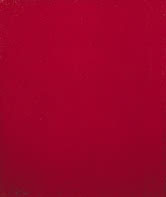
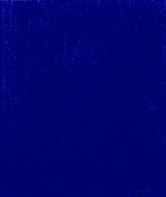
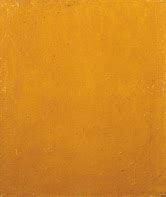
The first non-figurative monochromes were constructed by Aleksandr Rodchenko in 1921. Along with two other paintings by Rodchenko ("Line" and "Cell"), they were exhibited in September 1921 in the first installment of the two-part exhibition 5x5=25 in Moscow. The other participants were Varvara Stepanova, Aleksandra Ekster, Liubov Popova, and Aleksandr Vesnin.


"I reduced painting to its logical conclusion and exhibited three canvases: red, blue and yellow. I affirmed: it's all over. Basic colors. Every plane is a plane and there is to be no representation."

Aleksandr Rodchenko


Link

Rodchenko Retrospective, Museum of Modern Art, New York, 1998.

Pure Red Color
(Chistyi krasnyi tsvet)

Pure Blue Color
(Chistyi sinii tsvet)

Pure Yellow Color
(Chistyi zheltyi tsvet)

"From here, Constructivism proceeds to the negation of all art in its entirety, and calls into question the necessity of a specific activity of art as creator of a universal aesthetic."

Varvara Stepanova: Lecture on Constructivism, 22 December 1921.
In: Peter Noever: Aleksandr M. Rodchenko - Varvara F. Stepanova. The Future Is Our Only Goal.
Munich: Prestel, 1991, pp. 174-178.


UNOVIS: Monochromes, 1923


UNOVIS - Champions of the New Art (Kazimir Malevich, Vera Ermolaeva, El Lissitzky, Ilya Chashnik, Nikolai Suetin, Anna Leporskaya, Lev Yudin, Evgenia Magaril, Lazar Khidekel).

Unovis exhibited 2 white (or grey?) monochromes in the exhibition "Works of Petrograd Artists of All Movements" (May 1923) at the Petrograd Art Academy.


Remko Scha, 2004/2008