back to: things radical art (home page)
Wrappings
|
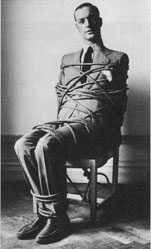
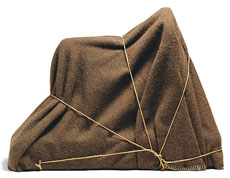
Man Ray: L'Énigme d'Isidore Ducasse, 1920 |
|
|
|
|
|
|
|
|
|
|
|
|
|
|
||
|
|
|
|
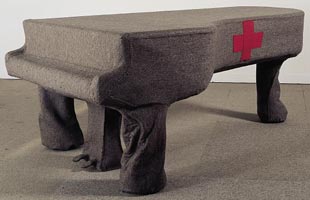
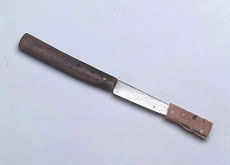
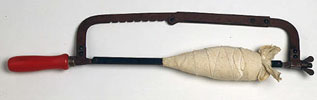
Erik Dietman: The Sick Saw, 1961 |
Erik Dietman: |
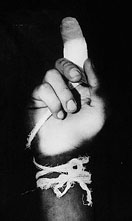
Joseph Beuys: Wenn Du Dich schneidest, verbinde nicht den Finger sondern das Messer. (1962) |
|
|
|
|
|
|
|
Quotes
Plutarch, On Isis and Osiris, § 9 (354 C). Christ did not hide truths in order to prevent them from being communicated, but in order to provoke desire for them by this very concealment. Saint Augustine: Sermons, 51, 4, 5. The more these things seem to be obscured by figurative words, the sweeter they become when they are explained. Saint Augustine: On Christian Doctrine, iv, vii, 15. But in order that manifest truths should not become tiring, they have been covered with a veil, while remaining unchanged, and thus they become the object of desire; being desired, they are in a way made young again; with their youth restored, they enter the spirit gently. Saint Augustine: Letters, 137, V, 18. These things are veiled in figures, in garments as it were, in order that they may exercise the mind of the pious inquirer, and not become cheap for being bare and obvious ... For being remote, they are more ardently desired, and for being desired they are more joyfully discovered. Saint Augustine: Against Lying, X, 24. Vielleicht ist nie etwas Erhabeneres gesagt oder eine Gedanke erhabener ausgedrückt worden als in jener Aufschrift über dem Tempel der Isis (der Mutter Natur): "Ich bin alles was da ist, was da war und was da sein wird, und meinen Schleier hat kein Sterblicher aufgedeckt." [Perhaps nothing more sublime has ever been said or a thought has been expressed more sublimely, than in that inscription on the temple of Isis (Mother Nature): “I am all that is, that has been, and that shall be, and no mortal has raised my veil.”] Immanuel Kant: Kritik der Urteilskraft, 1790. (§ 49, footnote.) If you wrap up different kinds of furniture in enough wrapping paper, you can make them all look the same shape. Ludwig Wittgenstein. SourcesThe veil of Isis is discussed at length in a monograph by Pierre Hadot: The Veil of Isis. An Essay on the History of the Idea of Nature. Cambridge, MA: Harvard University Press, 2006. The pronouncements by Saint Augustine were taken from pp. 76/77 of Catherine Porter's English translation of Tzvetan Todorov: Théories du Symbole (Paris: Éd. du Seuil, 1977). [English translation: Theories of the Symbol. Ithaca, NY: Cornell University Press, 1982] The Wittgenstein quote is from John R. Searle: The Rediscovery of the Mind. Cambridge, Mass.: MIT Press, 1992, p. 126. |