Everything       Radical Art           


Nature as Art


    Process Art

    Natural Disasters

    Physics

    Animal Art


Miscellaneous material

Charles Eames: Blacktop (1952). 10'47".

This film shows the shapes produced by the movement of soapy water across an asphalt surface. Don Albinson controlled the hose and movement of the water. Eames edited the film and synchronized it to Bach's Goldberg Variations on the basis of visual cues from the film's optical track.

Jan Henderikse: The San Pedro Art Project, 1973. (Three artificial lakes.)

Wolfgang Mally: Paper in Water 0-58 Days, 1977/1978.

Mally placed 365 sheets of paper in water, earth and air, and removed one sheet every day. (Dorothea Eimert: PaperArt, Geschichte der Papierkunst. Wienand Verlag, 1994.) (Cf. Marcel Duchamp: Readymade Malheureux, 1919; and some pieces by Yves Klein.)

Jan Henderikse: Ice, 1981.
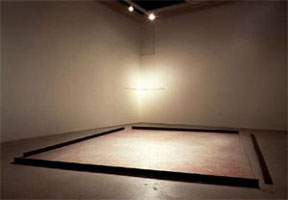
Yukinori Yanagi: Wandering Position, 1995.

"The plan for Wandering Position, which will be executed on-site, is to set an ant free within a square area surrounded by a steel frame. The artist will follow the ant and trace his own footsteps in pastel. Only the size and position of the enclosure are to be determined by the artist. The rest will be drawn according to the ant's "will."

Asa Elzen: Communiejurkje, 1998.

A glass container with water and salt. The water dries out and leaves a pattern of salt crystals.
(Catalogue Flexible 3, close to the body. Nederlands Textielmuseum, Tilburg - 2000.)

(Trace of pendulum in sand during earthquake.)

Ken Goldberg, Randall Packer, Wojciech Matusik and Gregory Kuhn: Mori, 2001.

Ongoing display of earth movements in Berkeley, CA.      

Wim van Egmond, Loes Modderman, Spike Walker, Karl E. Deckart: Photomicrographs.
Michael W. Davidson: Photomicrographs.


Reference


Jan Henderikse: Photo. Installations 1960-1992. Almere: Directie Kunstzaken / Amsterdam: Galerie . Apunto, 1992, pp. 15, 18-19, 47.

.


Simulations

Steam: Kevin Newman: Smoke. (<5k Flash 5, 2002.)
Erosion: Bit-101 Laboratory: 01 dec 08/12/20; 02 dec 23-25
Explosion: Bit-101 Laboratory: 01 dec 11


Quotes


". . . love of nature can so easily be conciliated with the primacy of utility, [. . .] that it has been the most common – and the most harmless – means of compensating for utilitarian societies. There is obviously nothing less dangerous, less subversive, or even less wild than the wildness of rocks."

Georges Bataille: La Littérature et le Mal. Paris: Gallimard, 1957.
(English trans.: London: Calder and Boyars, 1973, p. 56.)

"La mer est plus belle que les cathédrales."

Paul Verlaine. (Cited by: Theodor W. Adorno: Ästhetische Theorie (Frankfurt am Main, 1973), p. 103.)

Man könnte sagen: die Kunst zeige uns die Wunder der Natur. Sie basiert auf dem Begriff der Wunder der Natur. (Die sich öffnende Blüte. Was ist an ihr herrlich ?) Man sagt: "Sieh, wie sie sich öffnet!"

Ludwig Wittgenstein, 1947. (Vermischte Bemerkungen, p. 109.)

Der Mathematiker (Pascal), der die Schönheit eines Theorems der Zahlentheorie bewundert; er bewundert gleichsam eine Naturschönheit. Es ist wunderbar, sagt er, welch herrliche Eigenschaften die Zahlen haben. Es ist, als bewunderte er die Regelmässigkeiten einer art von Krystall.

Ludwig Wittgenstein, 1942. (Vermischte Bemerkungen, p. 83.)

Ce n'est pas si naturel que cela de peindre, et si le peintre peint, c'est parce qu'il est un homme, et non un animal sécrétant des morceaux de toile colorée de différents formats, comme l'huître la perle, ou la seiche la sépia.

Raymond Queneau: "L'amour, la peinture", 1948.

In the Japanese canon, (. . .), there are eight methods of painting rocks, each based on the use of a highly adaptable unit of design, gathered from some phenomenon where it is clear and striking, such as axe strokes on a tree, the shape of alum crystals, hemp leaves, the wrinkles in a cow's neck.

Susanne K. Langer: Mind: An Essay on Human Feeling, Vol. I. Baltimore: Johns Hopkins University Press, 1967, pp. 173/174. (Based on: Henry P. Bowie: On the Laws of Japanese Painting. New York: Dover, 1951.)


Music: The Aeolian Harp

Howard Dearstyne: Material Compiled on the Subject of the Aeolian Harp from Various Sources. Williamsburg, VA: Colonial Williamsburg, Inc., 1954.

Stephen Bonner: The history and organology of the Aeolian harp.

Stephen Bonner and M. G. Davies: The acoustics of the Aeolian harp. Bois de Boulogne, 1974

Mins Minssen et al.: Äolsharfen: der Wind als Musikant. Universität Kiel, Institut für die Pädagogik der Naturwissenschaften, 1997.


Exercises:
  •    Make computer simulations of some natural phenomena.
  •    It has often been observed that Immanuel Kant's analysis of the aesthetic experience focusses on beauty in nature, and that the status of art in his theory is problematic. Discuss against this background the "Nature as Art" genre in the art of the 1960's. Take into consideration also: Duchamp's readymades, algorithmic art, and Artificial Life.


Remko Scha, August 2002 / January 2003.

Some works and links suggested by Chris Alderliefste, Jorn Baas, Maja Brouwer, Daniel Marcel Joosse.